
San Bruno, CA · San Mateo County
Smoke and Carbon Monoxide Detector and Fire Extinguisher Self-Certification (R-1 and R-2)
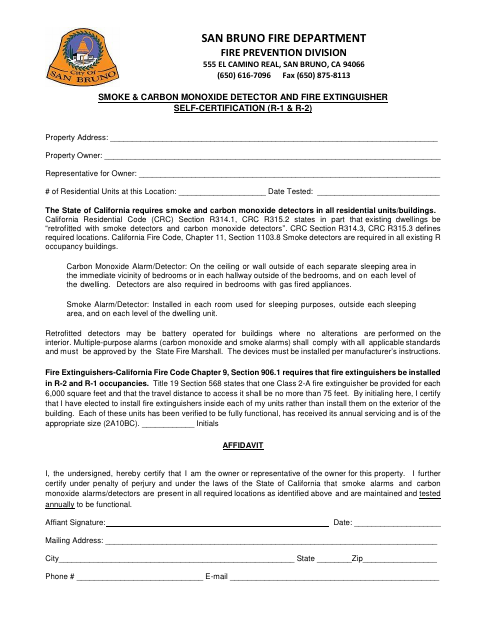
This self-certification form is for property owners or their representatives to report required smoke and carbon monoxide alarms and fire extinguisher details.
What this form is
Property owners or their representatives use this form to certify that smoke and carbon monoxide alarms are present in the required locations, maintained, and tested annually. It also records the property address, number of residential units, testing date, and fire extinguisher information. The signer can initial the statement about installing extinguishers inside each unit and must provide an affidavit, signature, date, and contact details.
Who needs it
A property owner or the owner’s representative can complete this form to certify detector locations and maintenance and provide fire extinguisher information.
How to submit it
Submit it to the city department named on the form; check the city website for current contact details.
About notarization
This document is signed without a notary; its affidavit certifies under penalty of perjury, and the owner or representative signs and dates it.
How to submit this form
- 1
Download The Form
Download the Smoke and Carbon Monoxide Detector and Fire Extinguisher Self-Certification form.
- 2
Complete Property Details
Enter the property address, owner or representative, number of residential units, and date tested.
- 3
Review And Certify
Complete the fire extinguisher section, then sign and date the affidavit as the owner or the owner’s representative.
- 4
Submit To The City
Submit it to the city department named on the form; check the city website for current contact details.
Frequently asked questions
- What does the San Bruno self-certification cover?
- It certifies that smoke and carbon monoxide alarms are in required locations, maintained, and tested annually. It also asks for fire extinguisher details and property information.
- Who can sign the self-certification?
- The form identifies the signer as the property owner or a representative of the owner. The signer provides an affidavit, signature, date, and contact information.
- Do I need a notary for the self-certification?
- No. The document has no notary block. The owner or representative signs and dates its affidavit, which certifies under penalty of perjury.
- How do I submit the self-certification?
- Submit it to the city department named on the form; check the city website for current contact details.