
Cranford, MT · Union County
Claim for Property Tax Exemption on Dwelling of Disabled Veteran or Surviving Spouse
Disabled veterans and qualifying surviving spouses use this claim to request a property tax exemption for their principal residence.
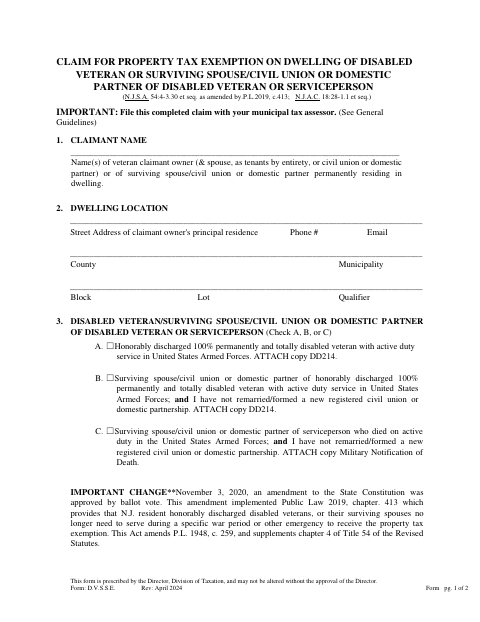
What this form is
This claim requests a property tax exemption for a dwelling owned and occupied as a principal residence by an eligible disabled veteran or qualifying surviving spouse, civil union partner, or domestic partner. The form asks for claimant, property, military service, disability, ownership, occupancy, and residency details. File it with the municipal tax assessor and attach documents supporting eligibility.
Who needs it
A disabled veteran or eligible surviving spouse, civil union partner, or domestic partner seeking this exemption for an owned principal residence needs this claim.
How to submit it
File the completed claim with the municipal tax assessor at any time during the tax year. Attach copies of documents supporting eligibility, as necessary to establish the claim.
About notarization
This claim is signed and dated without a notary; its certification is considered made under oath, but the form does not request notarization.
How to submit this form
- 1
Download the Claim
Download the property tax exemption claim and review its guidelines.
- 2
Complete the Claim
Provide claimant and dwelling details, then complete the applicable military status, disability, ownership, occupancy, and residency sections.
- 3
Gather Supporting Documents
Attach copies of documents needed to establish eligibility, such as military, disability, ownership, residency, or relationship records.
- 4
Submit to the Tax Assessor
File the completed claim with the municipal tax assessor at any time during the tax year.
Frequently asked questions
- Do I need a notary for the disabled veteran property tax exemption claim?
- No. The claim has a signature and date field but does not request notarization. Its certification is considered made under oath; the form does not require a notary.
- How do I submit the disabled veteran property tax exemption claim?
- File the completed claim with the municipal tax assessor at any time during the tax year. The guidelines say to attach copies of documents that establish eligibility, as necessary.
- What documents should I attach to the claim?
- The form calls for a DD214 for certain veteran claims or a Military Notification of Death for a qualifying serviceperson claim. Guidelines also list proof of disability, ownership, residency, and, for surviving claimants, relationship and death documents.
- Who can claim this property tax exemption?
- The form covers an honorably discharged, 100% permanently and totally disabled veteran, certain surviving spouses or partners, and a surviving spouse or partner of a serviceperson who died on active duty. Eligibility requirements also include ownership, principal residence, and New Jersey residency.
Need something notarized?
This Claim for Property Tax Exemption on Dwelling of Disabled Veteran or Surviving Spouse doesn’t need a notary — but if you have another Cranford form that does, a commissioned online notary can help.