
Notary glossary
Self-Proving Affidavit
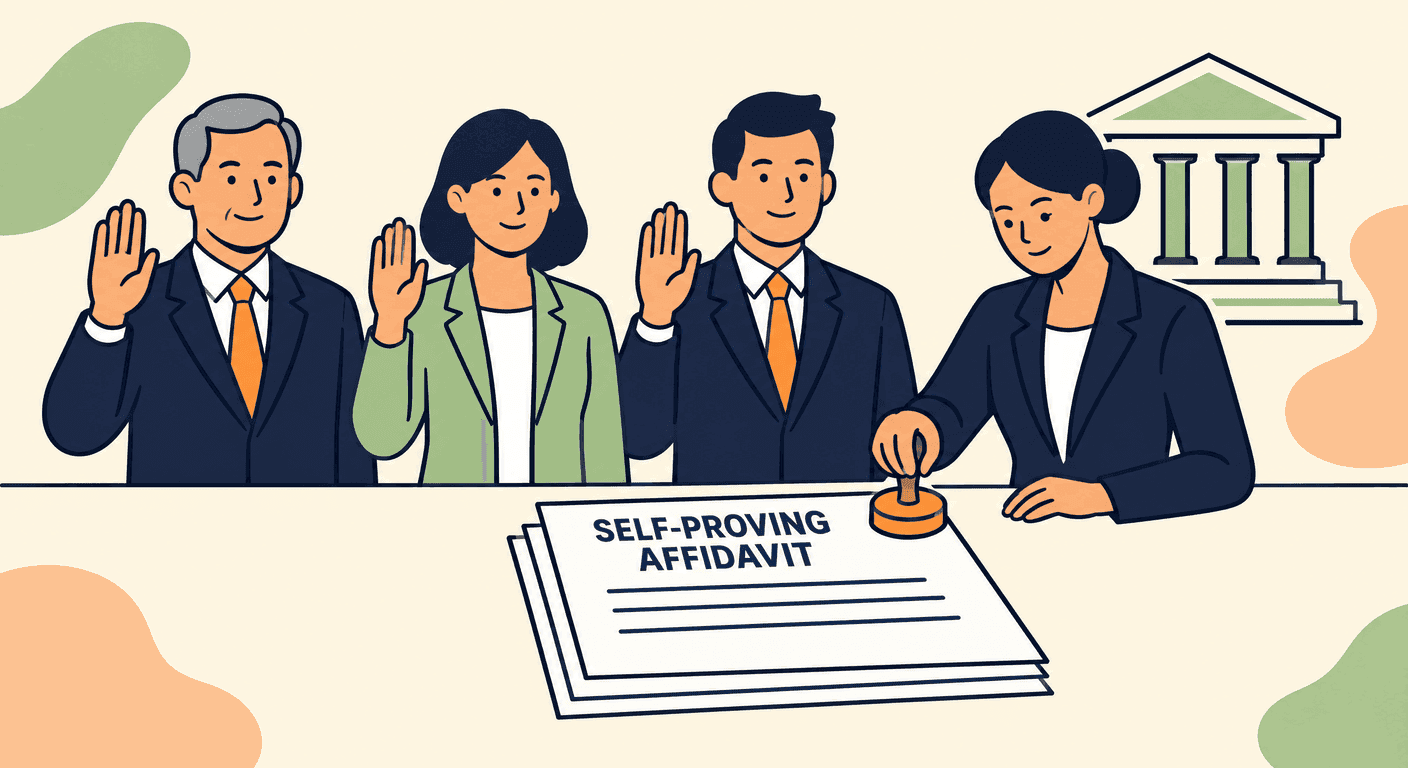
A self-proving affidavit is a sworn statement attached to a will in which the testator and the witnesses confirm, in front of a notary, that the will was signed and witnessed properly. Its only job is to save trouble later: with one attached, a probate court can usually accept the will without locating the witnesses and asking them to testify, which may be years or decades after the signing.
What problem it solves
A will normally has to be proved before a court will act on it, and traditionally that meant producing the people who watched it being signed. Witnesses move, lose touch, forget, and die, often before the testator does. Proving a will that way can turn into a genuine obstacle at exactly the point when the family least wants one.
The self-proving affidavit front-loads that evidence. The witnesses swear to the circumstances while the memory is fresh and the notary records it, so the sworn statement stands in for their later testimony.
Who has to sign, and in front of whom
Typically the testator and both witnesses sign the affidavit, and all of them must appear before the notary. This is the part that catches people out: it is not a document the testator can take away and have notarized alone afterwards. The witnesses are the point of it.
The notary does not witness the will: that is the witnesses' job, and in most states a notary cannot count as one of them. The notary administers the oath on the affidavit and completes the certificate.
The affidavit is not the will
The two are separate documents that usually travel stapled together. The will is signed and witnessed under the formalities the state requires; the affidavit is a sworn statement about that signing. A defective affidavit does not invalidate a properly executed will, it just means the will has to be proved the old way.
The reverse is also true, and more important: a self-proving affidavit cannot rescue a will that was not validly executed in the first place. It is evidence of the formalities, not a substitute for them.
Why state law matters more than usual here
Wills are the area where state-by-state variation is at its widest. The wording the affidavit must use, how many witnesses are required, who may act as one, and whether a self-proving affidavit is recognised at all are set by each state's probate code, and several states prescribe near-exact statutory language.
Timing varies too. Many states allow the affidavit to be executed at the same time as the will or at any point afterwards, while others are stricter. Because the consequences surface after the testator has died, when nothing can be corrected, this is a document to get right with an estate attorney rather than to assemble from a template.
Online notarization and wills
Wills are the most commonly excluded document type in remote online notarization law. A number of states that otherwise permit RON carve out wills, codicils and testamentary trusts specifically, and some that allow electronic wills impose separate requirements on how they are signed and stored.
Treat an online session for a self-proving affidavit as something to verify first rather than assume. Check what your state permits, and confirm with the attorney who drafted the will: the cost of being wrong lands on the estate, long after it could be fixed.
Common questions
Can a notary be one of the witnesses to a will?
In most states, no: the notary administers the oath on the affidavit rather than witnessing the will, and the roles are kept separate. A handful of states take a different view. Because the consequence only surfaces at probate, follow the drafting attorney's instruction rather than a general rule.
Is a will valid without a self-proving affidavit?
Yes, provided it was executed with the formalities the state requires. The affidavit is a convenience that makes probate simpler; its absence means the will has to be proved by other means, usually witness testimony.
Can a self-proving affidavit be added to an existing will?
In many states, yes: the testator and the original witnesses can execute one later in front of a notary. It depends on the state's probate code and on being able to find the same witnesses, which is often the reason it was not done at the time.
Related terms
Affidavit
A written statement of facts that the signer swears or affirms is true in front of a notary. City permit packets are full of them: owner-builder affidavits, roofing affidavits, survey affidavits. An affidavit needs a jurat, not an acknowledgment.
Affiant
The person who signs an affidavit and swears or affirms that its contents are true.
Jurat
A notarial act where you sign the document in the notary's presence and swear or affirm that its contents are true. The certificate reads "sworn to (or affirmed) and subscribed before me". Affidavits and sworn applications use a jurat.
Notarial certificate
The wording the notary completes and signs on the document: the venue (state and county), the date, the type of act (jurat or acknowledgment), the signer's name, and the notary's signature and seal. If a form has no certificate, the notary attaches a loose one.
General notary practice, not legal advice, rules on identification, witnesses and which documents may be notarized online are set by each state. See the requirements page for your state, or browse the full notary glossary.
The notary guides cover where to get a document notarized and what each option will and will not handle, the FAQs explain how a session runs, and the document guides cover specific paperwork. When you are ready, start a session.