
Oakland County, MI · Oakland County
Request and Writ for Garnishment (Nonperiodic)
A judgment creditor or their representative completes this form to request a writ for garnishing a debtor’s nonperiodic property or obligations.
At a glance
- Issued by
- City of Oakland County · Oakland County, Oakland County, Michigan
- Notarization
- Not required: file this form without a notary.
- Official source
- courts.michigan.gov
- Blank form
- Download the PDF
- Catalogued
- Machine-readable
- JSON record · about the forms index
What this form is
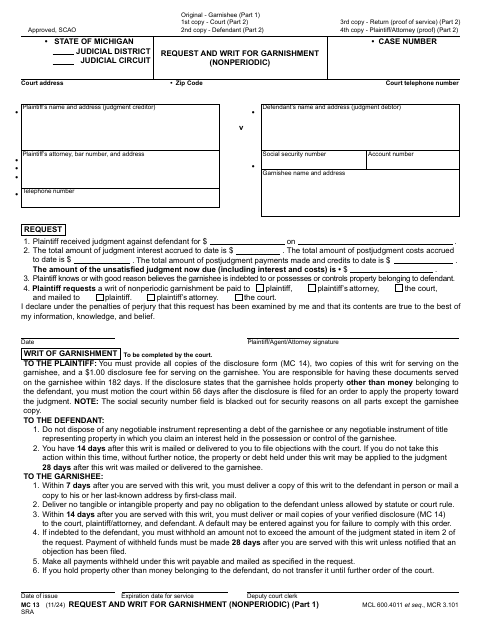
A judgment creditor uses this form to ask the court to issue a nonperiodic garnishment writ when they believe a garnishee owes the debtor money or holds the debtor’s property. The request lists judgment details, interest, costs, payments, and the amount still due, along with identifying information for the parties and garnishee. The court completes the writ section.
Who needs it
A judgment creditor, agent, or attorney seeking to garnish a debtor’s nonperiodic property or obligations completes the request section.
How to submit it
Provide the disclosure form (MC 14), two copies of the writ, and the disclosure fee for serving the garnishee. Arrange service within 182 days and file proof of service with the court clerk.
About notarization
This document is signed without a notary; the request and proof-of-service sections contain declarations under the penalties of perjury, and the signer signs and dates them.
How to submit this form
- 1
Download the Form
Download the Request and Writ for Garnishment (Nonperiodic) PDF.
- 2
Complete the Request
Enter the judgment amounts and the plaintiff, defendant, and garnishee information requested on the form.
- 3
Gather Required Items
Provide all copies of disclosure form MC 14, two copies of the writ for serving on the garnishee, and the disclosure fee.
- 4
Arrange Service and File Proof
Have the documents served on the garnishee within 182 days and file proof of service with the court clerk.
Frequently asked questions
- Who completes the Request and Writ for Garnishment?
- The plaintiff, agent, or attorney completes the request section. The court completes the writ section, and the process server completes the proof-of-service section.
- Do I need a notary for the Request and Writ for Garnishment?
- No. This document is signed without a notary. The request and proof-of-service sections include declarations under the penalties of perjury, which the signer signs and dates.
- How do I submit the Request and Writ for Garnishment?
- Provide MC 14, two copies of the writ, and the disclosure fee for service on the garnishee. Arrange service within 182 days and file proof of service with the court clerk.
- What information does the request ask for?
- It asks for judgment and balance details, plaintiff and defendant information, garnishee information, and identifying details that can help the garnishee identify the defendant.