
Shiawassee County, MI · Shiawassee County
Garnishee Disclosure
Garnishees complete this court form to report whether they hold a defendant’s property or owe the defendant payments under a writ of garnishment.
At a glance
- Issued by
- City of Shiawassee County · Shiawassee County, Shiawassee County, Michigan
- Notarization
- Not required: file this form without a notary.
- Official source
- shiawassee.net
- Blank form
- Download the PDF
- Catalogued
- Machine-readable
- JSON record · about the forms index
What this form is
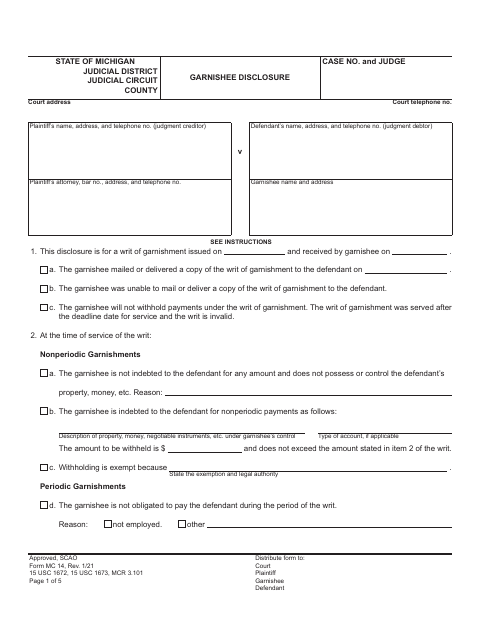
This form lets a garnishee disclose whether they owe payments to a defendant or hold the defendant’s money or property under a writ of garnishment. The instructions say to complete and deliver copies to the court, plaintiff, and defendant within 14 days after service, even if no money is owed. It asks about the writ, payments, withholding, and any higher-priority writ or order.
Who needs it
A person or business served as a garnishee on a writ of garnishment uses this form to disclose information about the defendant’s payments or property.
How to submit it
Mail the original to the court and one copy to the plaintiff. Mail or hand-deliver a copy to the defendant, and keep one copy for your records.
About notarization
This disclosure is signed without a notary; it includes declarations under penalties of perjury, and the garnishee signs and dates it.
How to submit this form
- 1
Download the Form
Download the Garnishee Disclosure PDF.
- 2
Complete the Disclosure
Enter the writ and receipt dates, report the garnishee’s obligations or property, and complete the applicable withholding information.
- 3
Prepare Copies
Separate the copies as instructed. The form also includes an optional calculation sheet for earnings garnishments.
- 4
Send the Copies
Mail the original to the court and one copy to the plaintiff; mail or hand-deliver a copy to the defendant and keep one for your records.
Frequently asked questions
- What is the Garnishee Disclosure used for?
- A garnishee uses it to tell the court, plaintiff, and defendant whether they owe the defendant payments or hold the defendant’s property under a writ of garnishment.
- When should the garnishee submit this form?
- The instructions say to deliver or mail copies to the court, plaintiff’s attorney or the plaintiff, and the defendant within 14 days after being served with the writ.
- Do I need a notary for the Garnishee Disclosure?
- No. The disclosure is signed without a notary, but it includes declarations under penalties of perjury that the signer dates and signs.
- How do I submit the Garnishee Disclosure?
- Mail the original to the court and one copy to the plaintiff. Mail or hand-deliver a copy to the defendant, and keep one copy for your records.