
Livermore, CA · Alameda County
Junior Accessory Dwelling Unit Deed Restriction
A recorded Declaration of Restrictions that a Livermore property owner signs before the Building Division finalizes a permit converting part of a single-family home into a Junior Accessory Dwelling Unit.
- California-licensed notary
- ~15 min average
- Notarized PDF emailed
What you’ll need
- Government-issued photo ID
- Webcam-enabled device (laptop or phone)
- This form, ready to upload as a PDF
What this form is
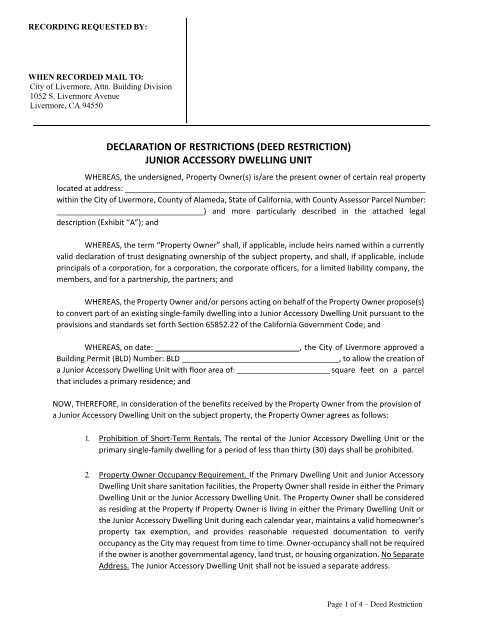
Livermore requires owners creating a Junior Accessory Dwelling Unit under Government Code Section 65852.22 to record this deed restriction with the Alameda County Recorder. It prohibits rentals shorter than 30 days, bars selling the JADU separately from the primary dwelling, and requires owner occupancy when the units share sanitation facilities. The covenants run with the land and bind all future owners, and the City may enforce them through fines or legal action.
Who needs it
Livermore homeowners who have obtained or are finalizing a building permit to convert part of an existing single-family residence into a Junior Accessory Dwelling Unit.
Why it needs a notary
The form includes a California notary acknowledgment on page 3 because the deed restriction must be recorded with the Alameda County Recorder, and recorded instruments require notarized owner signatures.
How to get this notarized
- 1
Download the Form
Download the JADU Deed Restriction Form from the City of Livermore Permit Center Applications and Forms page.
- 2
Fill In Property Details
Enter the property address, Assessor Parcel Number, building permit number, JADU square footage, and attach the legal description as Exhibit A.
- 3
Book an Online Notary
Schedule a remote online notarization session with Rush Notary and upload the completed PDF.
- 4
Sign on Video
All property owners appear on the video call with valid photo ID and sign the deed restriction while the notary completes the acknowledgment.
- 5
Record and Submit
Record the notarized deed restriction with the Alameda County Recorder and return a conformed copy to the Livermore Building Division to finalize your permit.
Preview the form
The blank PDF straight from Livermore. Look it over, then upload your filled copy to start the notary session.

You’ll need ID and a webcam.
A licensed California online notary will join you on video, verify your government-issued ID, witness your signature, and apply their seal. You’ll receive the notarized PDF by email when the session ends.
Frequently asked questions
- What is the Livermore JADU Deed Restriction form?
- It is a Declaration of Restrictions the City of Livermore requires when you create a Junior Accessory Dwelling Unit. It limits short-term rentals, prohibits separate sale of the JADU, and sets owner-occupancy rules, and it is recorded against your property.
- Do I need to have the JADU deed restriction notarized?
- Yes. The form contains a California notary acknowledgment for the property owner signatures because the document is recorded with the Alameda County Recorder, and recorded deeds and covenants must be notarized.
- How do I get the JADU deed restriction notarized online?
- Download the form, fill in the property address, APN, permit number and legal description, then book a remote online notarization session. You will sign on video with an online notary, receive the notarized PDF, and submit it to the City and County Recorder.
- Will the City of Livermore accept a remote online notarization?
- California recognizes notarial acts performed by out-of-state notaries under Civil Code Section 1189(b), and many recorders accept them. Check with the City of Livermore Building Division or the Alameda County Recorder if you are unsure.
- Who has to sign the JADU deed restriction?
- Every owner of record of the property must sign, including trustees, corporate officers, LLC members or partners where the property is held in an entity, and each signature must be acknowledged by a notary.